How much does a logo design cost?
You need a logo, but no one will tell you what it costs to design one, here’s why.

How much did the Nike logo cost?
$37
How much did the BP logo cost?
$211,000,000
Blows your hair back, right?
This is the reality of the cost of a logo, it could be anything.
Now to be fair, the Nike logo was designed in 1971 by Carol Davidson at the time Nike rebranded from Blue Ribbon Sports to its now famous name.
While the cost of the BP logo redesign was not just for a logo alone, as it included a whole rebrand and the implementation of that new logo across thousands of service stations.
And that right there is how you should stop thinking solely about how much a logo design costs and reframe it to realise it’s never just the design of the logo itself that needs to be considered to see better business success from better branding.
But seriously, what does a logo cost to design?
A logo could be designed for FREE by you, by me, by a friend of yours, or even by AI. Though I would not recommend AI in the slightest as you won’t own the copyright, which is not ideal for any business. So a logo could be designed for free, though if you’re short on that skillset or don’t know anyone willing to do so, even in exchange for a case of beer, then you’ve gotta be more realistic to realise this is going to cost something, like everything in business.
What’s also going to cost you in business is the risk of not getting it right. Because it’s the same as saying, what’s the cost of your product not standing out on the shelf? What’s the cost of someone not being able to remember or recognise your business when they need you?
Any good business that is fighting for a leading market share can’t stuff up any part of their operations, their distribution, their marketing and their branding, and it’s a risk any leading business can’t afford. This is why something like the cost of a logo design can vary from $5-$100 from a designer on a website like Fiverr, all the way up to the millions of dollars for businesses that shoulder great risk in changing their branding, especially for a logo if it’s the most distinct and recognisable part of their brand.
Now remember how I said Nike’s logo cost $37, which is 100% true, but even so, today that logo is said to have a market value of around $30Billion. Do you think Nike would be messing with that logo, let alone considering what the cost of the risk in changing it would be? No.
But let’s say you’re either starting a new brand, or you’re a small-to-medium business and believe your brand needs a change of logo, what does that cost?
For an average entry level designer, you’d be looking at $100-$500 for a logo.
For a freelance designer with good experience and possibly a reputable name, $1,500-$10,000 for a logo.
For a small agency to design your logo, it’d be in a ballpark of $5,000-$40,000.
For a large nationally or internationally present agency to design your logo, it’d be anywhere from $50,000 all the way up to $1,000,000+.
Why the discrepancy, even between each of these tiers?
Well, apart from a higher likelihood of getting a far better result if you at least pay more than $100-$500 for a logo, it comes down to cost + price.
Cost for a logo design relates to the overheads incurred and geographic location the designer is. Meaning the cost factors of a freelance designer in a lower-socioeconomic region like India or Africa are going to be worlds apart from a large agency of 100 people in a city like New York, London or Sydney.
As for price, there are multipliers that increase the rate you will be charged for a logo and branding. These include:
For a designer/agency: Quality of work (with a demonstrated body of work to prove it)
For a designer/agency: Level of experience
For a designer/agency: Reputation (be it Google Reviews, or a strong word-of-mouth, or industry reputation that precedes them)
For your business: The size of your business (locations, amount of employees, customers, etc)
For your business: Fame (how well known are you in your market(s))
For your business: Risk to change (eg. if you have a highly recognised logo already, how much would it impact your business if it radically changed its logo?)
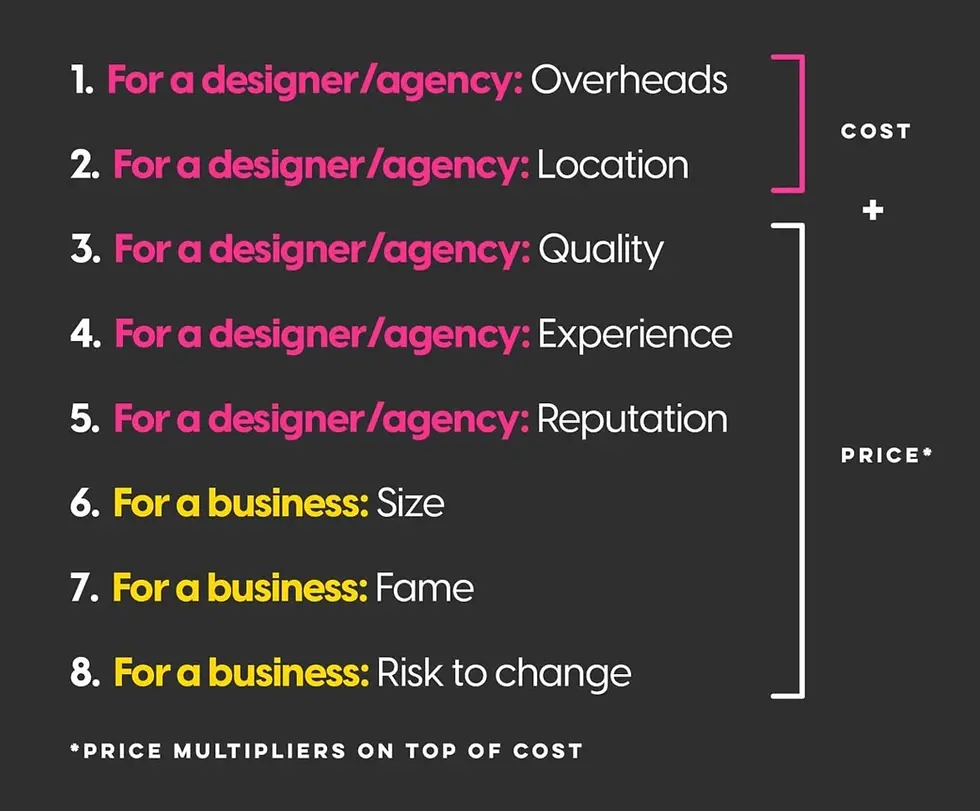
The higher each of these multipliers are, it is realistic to expect that a logo will end up being priced higher. As cost is what it costs the person or agency to design it, while price is what will be charged. But this is the price to pay for a great logo.
What makes a great logo?
Some say a great logo is timeless, simple and doesn’t need to communicate what the brand does to be effective. While others might argue that a great logo is deemed great because of the success of the business and brand it represents. Now I’m a firm believer that it’s a combination of all these things, though I’m dubious of a logo being great just because it subjectively looks really cool.
I’m more in the camp that suggests a logo needs to be effective above all else. So how do you ensure you get an effective logo?
1. Identification
Is it unique to identify in the crowd? It needs to be a unique mark or designed word that doesn’t need to be fancy and overly colourful, it doesn’t need to allude to what your business does, but it does need to be a logo that can be easily identified.
2. Recognition
Can you recall it from memory? If it’s too complex it might be forgettable unless a customer is exposed to it hundreds of times. So start as simple as possible, as we also need a customer to remember all the associations that come with your brand to think of them when they see your logo.

3. Usability
Is it versatile enough to work in any situation? Is it legible and/or identifiable at small scales? Can it be reproduced in a difficult context like embroidery? Can it work with only one colour? Is it scalable to infinite sizes? I even made a point of it with my own logo that I could mow it into the grass of my backyard)

4. Communication
Of course you can add personality to enhance Identification and Recognition but not at the expense of the first three criteria. For example, another house logo for a real estate agent is as predictable as a plumber using a tap and wrench in their logo, unless it’s baked into your logo with a creative hidden meaning or a creative look to enhance that predictability.

So when you’re going through the process of designing a logo, keep this Logo Pyramid in mind and you’ll be doing better branding by creating an effective logo.
What is the process of creating a logo?
The Citi logo was drawn on a cocktail napkin at a restaurant, just the same as the Chupa Chups logo that is said to have been designed by Salvador Dali on a bit of newspaper. Now this isn’t to say that all great logos start over a coffee or business dinner, but there are certain considerations for how a logo is created to be effective.
Form
In my own process I typically start with an icon first, or what I call a logomark. Something that can uniquely identify the brand from a symbol alone in its simplest form, and then adding a wordmark to compliment the logomark that displays the brand name legibly. While other times it might only be a wordmark logo where a stylised word is designed. This process may take some time to develop a confident option, or a short time if you start with a great deal of clarity for what your brand is. Which is why a brand strategy process is always encouraged or mandated before you even get to a logo design process to help guide the concept for your brand as a whole and a logo as part of it.
Function
What many designers will also do is seek to create what is called a responsive logo. Meaning that your brand will have multiple logo options that meet certain needs for instances where a more detailed logo is not appropriate, for example, at smaller sizes like a social media profile image. And this where the function of your logo in terms of stress testing it across all likely touchpoints, will be considered. Which includes the logo colours and how it appears on different colours or image backgrounds.
Formats
In addition to different logo options and colour variations of your logo(s), efforts to create logo files in all different file formats like EPS (a vector format for infinitely scalable printing), SVG (a digital code-based file format to display your logo on a website), or PNG (a raster format image, meaning you can’t scale it beyond a certain resolution without losing quality, but it’s typically used for day-to-day digital uses like social media content and can support a transparent background). This also includes your logo files being created in print colour formats (CMYK/Pantone) and digital colour format (RGB) for screen use.
Competition and Trademark
It should be pretty obvious that we also don’t want a logo that looks anything remotely like a competitor or be mistaken for them, especially as this can bring up trademark infringement issues. But we also want it to be unique so that you can indeed trademark it and no other business in your market, region or even internationally has the same logo…which can happen!
When should you change your logo?
Hopefully never. Some brands like Coca Cola have stuck with their logo for over 100 years. While others that do, sometimes learn the harsh reality of humanity that is adverse to change. A brand like Cracker Barrel in the USA was pressured within 2 weeks to revert to their previous logo after intense nationwide backlash…which I think was blown way out of proportion, but it’s a case study of the risk you take when updating your branding.
That said there are times when a logo change is needed. Objectively what you have might be pretty terrible and while that might be a kick in the guts, the writing might be on the wall to update what was originally made on the fly when starting your business. Especially if it’s not up to the standards of what the leading competition is rocking. And to be frank, many small businesses have pretty dodgy logos at the best of times, especially because low budgets dictated the quality that could be afforded to make a logo, or the importance of branding and marketing was not valued, both at the time the business was starting up.
But there will come a time where a logo redesign will come to the forefront of necessity, be it because you had a dodgy one to start with, or because your business has matured or even changed its offering completely. There are many reasons to do so, but the best one is to refresh it.
You’ll see many brands doing this periodically over time as trends come and go or as their brand grows in fame over time. What typically happens is a refinement of their logo, oftentimes to become even simpler than their previous iterations. While others may even hark back to a previous logo iteration from the brand’s glory days to tap into a nostalgic brand play that invokes ‘all the feels’ from a time that made the brand what it is today.

What any logo change requires is restraint. To not go so far that the brand becomes unrecognisable by the logo alone, but also not so minimal that it loses all its quality of a memorable form. The best logo designers get this stuff right, but they’re sometimes at odds with brands that want to change ‘just because’, which often happens when new leadership comes along and they want to put their own stamp on things.

It’s never just a logo though
I said towards the start of this that you should stop thinking solely about how much a logo design costs and reframe it to realise it’s never just the design of the logo itself that needs to be considered to see better business success from better branding.
Many branding and marketing people/agencies have come to realise that compartmentalised design changes, like a logo refresh are in most cases, entirely superficial. Meaning that it doesn’t shift the needle and at most it just gives you something to talk about in a press release or social media post. But in the back end it requires a heavy amount of lifting to implement that change across all your touchpoints, especially if they are quite tangible like signage, stationery, clothing, packaging, etc.
So the point I want to impress upon you is that if you’re going to make a small change like your logo, make it part of a broader review of your brand in its entirety. Or if you’re just starting out, even if it’s a small corner shop business, do this too. So that it forms a wider brand effort to see success from. But where does it start?
Start with a strategy.
Now strategy is not hard, especially when you’re starting out as it’s simply a hypothesis for what you believe is going to help you win. For established businesses you use strategy to assess what is working and what isn’t, along with some tangible data to inform your decision making and establish a clear direction to achieve success…and part of those strategy objectives might indeed be to change your logo for a specific reason that will help shift the needle of your business.
A strategy to help your brand win is simply answering 4 questions:
What is the market need(s)/problem(s) and how are you going to deliver a solution?
Who are all the potential people that have these needs and problems?
Which of those people can we target based on who we can best help, that will be the most viable customers that are likely to buy?
What will they remember about our business to make it easy for them to remember and think of us when they have that need or problem?
That’s strategy and when you have those answers you can develop a strategic plan that answers 3 more questions:
What goals do we need to achieve to make sure these target customers think of us, find us and buy from us, to measure the success of this strategy?
What specific tasks will we do to achieve those strategy goals?
How much time and money can we spend on those tasks to implement them as that will dictate what tasks we prioritise first?
Now one of those goals will likely be to ensure there is a brand identity people can connect with. Both your customers and your team to align with. This is no different to who we are as people, a brand is not just what it looks like, just the same as our identities as people are not dictated by how we look. Which means an internal set of values, a clear purpose for why we do what we do, a collective personality we show up with d instill in all that we do, and a voice that is consistent when communicating. Couple all of that with how you externally show up with visual elements like colour, text, graphics, imagery and logos, as well as messaging, sounds, music and even smells. This is now a complex layer on top of your business offering that people can connect with.
This is an identity and it really holds tremendous weight and power in the added value your brand brings to your business as it gives people confidence in choosing you over others, be it rationally or irrationally. Even though it can feel far less tangible than a logo alone, it’s all part of a world you develop and invite people into that creates a significant impact. Of course that sounds so airy-fairy, but think about the times you might have bought something totally irrationally that cost significantly more than a comparable alternative. Maybe a $50 Nike t-shirt instead of a $5 one from Target, yeah? You paid for the Nike swoosh embroidered on the shirt, but you also bought into the associations Nike have made for you to want to be part of their brand world, to ‘just do it’ and feel part of a collective identity driven by a purpose that says ‘everybody’s an athlete’.
"I only need a logo"
You can’t tell me that a logo alone is going to be the thing that shifts the needle, or that you don’t need strategy, or don’t see the use in an identity. Because the brands that you know and buy from, those that really kick-ass in their markets, they put inordinate amounts of time, effort and budget into ensuring their brand is prioritised, maintained and grown. It’s why there are teams within these big organisations that are solely responsible for brand management. Because it holds value that is far beyond the cost of creating a logo, that yeah, the cost of which might sound unreasonable today even though it’s going to be the cheapest it ever will be to make or redesign your logo. Yes your business might be smaller, but is this not an indicator of what it takes, are these not the breadcrumbs to follow given success leaves clues like these? You need more than a logo.
Think about this, your brand and everything you do to give it value as the conduit between your company and customers, to connect one another, might be the only thing that appreciates in value within your business, that is, apart from the people in your team. If today your logo ‘costs’ you $5000 because that’s the price of getting it right with the right designer, what could it be worth if you give your brand a shot and take your branding and marketing seriously to see a 5x, 10x, 100x return on investment?
Because in business we’re fine with ongoing overhead costs like office space, distribution costs, insurance, company cars or electricity, but when it comes to the things that actually drive customers in the door like a one-time cost for branding, or an ongoing 5% of revenue marketing budget. This stuff is unfortunately never taken seriously or looked beyond the initial outlayed cost. It’s a nice to have. It’s dumped on the office receptionist to figure out. The marketing budget tap is turned off when business slows down, even though its sole function is to bring in business. For so many businesses, big and small, they fall into this frame of thinking. While their competition breeze past them because they saw the value in it. They ‘get it’.
Yes, this is me on my high horse, riding a saddle made of bias, but there’s so many reasons why the cost of a logo is insignificant to the value it delivers. Just the same as saying a brand is not your logo and it’s never just a logo alone that you should focus on. This is my wake up call to you, to give your brand a shot. This means better branding at every turn, an ongoing investment in marketing long enough to see results rather than giving up after 6 months. Better branding and marketing never starts with just a logo alone. It might cost a bit. But if it’s the jewel in the crown your business needs, then that’s what will help deliver better business success.
So think beyond cost, and see the value in your brand as a key factor of better business success.


Comments