Don't put your logo there
Use your logo effectively so your brand is recognised quickly and easily in these 4 situations.

IF LISTENING IS MORE YOUR THING, THIS ARTICLE IS ALSO AVAILABLE AS A PODCAST AUDIO EPISODE ON MY DOCTOR BRANDING PODCAST:
The common joke among logo designers is a client asking, “can you make the logo bigger?”. But you know what? It’s often not a bad call to have a logo not just be bigger, but the biggest thing someone sees on packaging, on billboards, stationery, social media, websites, apps, merch or signage.
There is of course a balance between getting your brand recognised and a visual hierarchy to prioritise what is most important in the situation your brand is being presented. So just like a newspaper, we can often follow the same formula of the most important things being the biggest and at the top as we visually scan our eyes from top to bottom, and left to right (mainly in cultures that write left to right).
But it doesn’t always mean your logo or other important information needs to necessarily be at the top, as context is also important when determining where to place the most important information. As each situation your brand is present, in combination with the level of brand awareness you have, and even category awareness, need to be weighed up to effectively communicate that it’s your brand and what you want people to see and/or read.
So here are 5 situations where your brand might show up to know where you shouldn’t put your logo to achieve better branding through greater brand awareness…and I’ve even made up a fictional potato chip brand ‘Sogol’ for these demonstrations (it’s Logos spelled backwards).
However, before I begin, you need to disregard everything you’ve seen the REALLY BIG brands do when it comes to these situations and scenarios. Because if you’re reading this, you likely don’t have 20-100 years of brand equity in terms of awareness and notoriety to do the same things the big brands can do, as your situation and goals are different to theirs.
1. Packaging
Scenario 1.
Do you hero the brand logo or the product name?
You’re a new brand and you have a completely new product that goes beyond a category norm, like Bachan’s Japanese Barbeque Sauce. So you’re the first to have a Japanese-style barbeque sauce on the supermarket shelf.
In this situation, customers aren’t aware of you just as much as they aren’t aware that japanese barbecue sauce was a thing. So what do you do when it comes to your packaging, do you hero your logo or the product name?
It’s a tough call because I certainly believe that you should take every opportunity to hero your brand first in every situation possible when you’re an unknown, to become known. That said, I think it was quite smart of a brand like Bachan’s to hero their product description at the top of their bottle and also not have a logo that stood out.
If Bachan’s were a new brand to market and just had another barbeque sauce branded in their own way, the better decision would have been to prioritise their brand first. However, as a new sub-category product, to help make customers aware that there’s this thing called Japanese Barbeque Sauce, it immediately differentiates them from their competitors, rather than distinctively setting themselves apart from their competitors with a different name/logo and bottle design.
Over time, Bachan’s grew their product awareness to the point where they could see the value in changing their product packaging, which can always be risky, to instead hero their logo at the top and make it more prominent last year. This is smart brand building and something we can all learn from in a scenario like this one.

Scenario 2.
Don’t let your logo be covered
To maximise the 1-5 second opportunity your brand has to stand out on a shelf among other products if it's placed on a shelf or in a vending machine. We want to ensure that your logo and product name is not covered by obstacles that might cover the bottom, top or sides of your product when displayed.
If your product is displayed on a shelf we don’t want these critical parts to be obscured by the packing box your product is displayed in, as many have bottom and side lips so that your product doesn’t slide off the shelf. Similarly, if your product is placed on a lower shelf well below eye-line, then your product can be obscured by the shelf above.
Because of this, it’s best to have your logo prominently displayed the biggest, but also a little further down from the top, and not too wide that it could be obscured by side lips of your packing box or even other products that might overlap over it. Beneath your logo have your product description that is measured to be no lower than the height of your packing box bottom lip.
This same kind of logo and product name placement is also applicable in vending machines or display stands, as multiple levels and stoppers at the front of these stands can block information at the top and bottom of your product.
In these kinds of product display situations, it allows you to determine the focal point first, being your logo and product name, and then decide the appropriate hierarchy of other information that is less critical. Like pack size/weight, product benefit callouts and brand messaging, that is less crucial if it were to be obscured on a shelf.
The point of this is to ensure your brand and product type is easily recognisable for customers to quickly spot and potentially choose once they lean in and pick it up.

2. Social Media
Scenario 1.
Don’t put your full logo in your social media page profile image
When a logo is designed well, the best designers will produce what’s called a responsive logo. This means having multiple variations of a logo so that it can be used in many different contexts where the logo can be displayed. One of which being a social media profile image and this is quite a common problem with many small businesses when they don’t have such logo assets to display their logo at a small scale like this.
The objective of an effective logo is to be able to scale infinitely and be recognisable at small scale, and this is why we see many brands have an icon/symbol (or logomark as I call them) as part of their logo. Or if they don’t have an icon, they will likely have a short brand name, rather than one that extends over 3 lines.
Now you might think when you start out that because people who discover your social pages won’t recognise you by an icon, that you need to put your full logo in your profile image so that it has the name of your brand too. However, this is not necessary at all, and if anything, it gives you a great opportunity to grow the awareness of your logomark on its own. Because your brand name is always going to sit alongside your profile image icon when displayed on any social media post and page of yours. Making a full logo redundant in that space, let alone being impossibly legible if you had your full logo in that space.

Scenario 2.
Don’t use your logo in your social media page profile.
If you’re effectively a one person service-based business, like I am for instance, use a photo of yourself rather than your business’ logomark in your social media profile image.
Look, you may want to seem bigger than you are and not give the impression that you are just some freelancer available for contract work, I totally get it. But it’s not to say you don’t have a business if you were to display a photo of yourself, or that you don’t have a team of people behind the scenes helping you out.
The thing is though, if you’re the one that is going to be the face of your business in your content AND the person your clients are going to engage with for the most part, then build a rapport with your audience and potential clients on face value. Build that relationship of initial trust in you rather than a faceless brand.
The alternative here is one we recommend a lot with real estate agents and is something I do as well. And that is to have separate business and personal pages. This ticks the boxes of putting on a business front in a business account on Facebook, Instagram and Linkedin, while sharing more content of you in videos and more personal views on a personal page that is a bit like a personal brand of sorts but still tied to your business account. The content on a personal page would still look branded the same as your business brand, but it allows you to create that interpersonal connection.
3. Billboards
Scenario 1.
Don’t put your logo at the bottom
Much like the packaging examples I gave before for logo placement, we don’t want our logo to be obscured and not easily seen. So for a scenario like an outdoor billboard that might be on something like a bus stop, ensure your logo is not at a height that is well below eyeline, in other words don’t put it at the bottom of your billboard and definitely not tiny.
The thing is with billboards is they’re seen when we’re walking or driving past it and a lot of the time we see them at a distance. So what we put on a billboard needs to communicate your brand even quicker than on your product that’s on the shelf at a supermarket. Which means, not a heap of text and information and no small logos.
We also need to think about placement based on the context of the billboard.
So if it’s a bus stop billboard ad on a busy street, if it’s likely going to be obscured by other people walking in front of someone or by other cars as someone drives past, would you (A) place your logo at the bottom? Or (B) place your logo or the top? The answer is B, you place your logo at the top so that if all someone sees is one thing (literally) above all others, it’s your logo.
The usual design choice is for a logo to be placed at the bottom left or right of billboards, so that it’s a bit of a full-stop or signature of who the message on the billboard is tied to. But apart from placing a logo where you can see it best at the top in a scenario like this, if you see the logo first, it can often make the message you’re communicating better understood if you at least have a bit of awareness down the track.

Scenario 2.
Don’t put your logo at the top
Again, it all depends on placement based on context. So in a scenario where a billboard is placed above people’s eyeline, like a billboard on the side of a building up high, the recommendation is to instead put the logo at the bottom in this scenario. Because when we people look up it will be the first thing we see if anything in that fleeting moment you have to get someone’s attention.
Scenario 3.
Don’t put your logo on the right.
This scenario can be a really tough call on where you put the logo, and that is when it’s an elongated horizontal billboard.
In markets where people read left to right, it makes the most sense to place your brand’s logo on the left side of the billboard in most instances, but again this all depends on context.
If it’s an elongated horizontal billboard on the side of a bus, my recommendation is to place the logo on the left of the billboard or no further than the centre. The bigger the better if possible.
However, if the elongated horizontal billboard is up high and if you’re walking towards it and it’s on a building to that person’s left, then my recommendation is to have the logo on the far left. And if it was on a building to their right, then have the logo on the far right of the billboard. In this instance, it’s not quite a hard and fast rule as people may of course be walking in both directions on that one side of the road, but for cars driving past, it’s more advantageous based on this example being in a region where people drive on the left side of the road, like Australia.
If the billboard is something they’ll directly pass under like over a highway, if the cars are driving on the left side of the road, have the logo on the lower left. Or if they drive on the right on the right side of the road, have the logo on the lower right side.
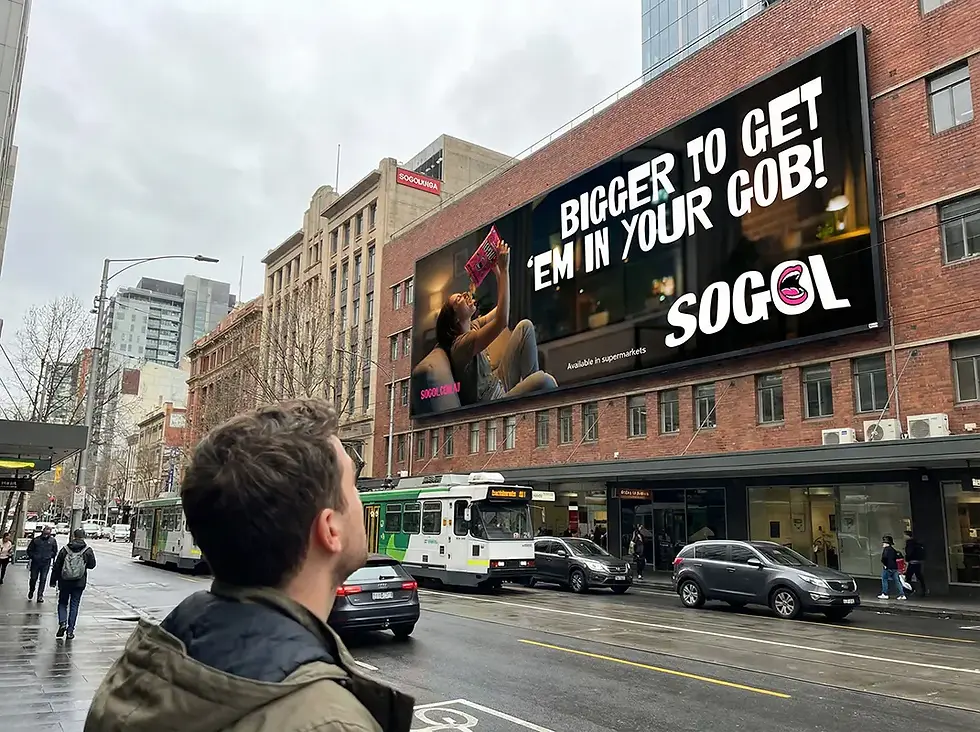
4. Video advertising
Don’t leave your logo to the end
It’s gotten to the point where we all know an ad as soon as we see one and we’re becoming conditioned to pay less attention to them because we’re faced with so much advertising in every media form.
So unless your strategy is to entertain up front to make it seem like something someone would want to watch and work in your brand into it, then you may as well get your brand and logo in there in the first 3 seconds someone sees your ad to get that touchpoint of recognition before they scroll past or tune out.
There’s an agency in the UK called System1 and they test ads for brands by measuring their effectiveness based on three criteria:
1. Star Rating: measuring how emotionally strong an ad is for a viewer.
2. Spike Rating: measuring how distinctive and attention-grabbing it is versus competitors.
3. Fluency Rating: measuring how easily and quickly it is recognised and processed by the viewer.
According to System 1, 83% of ads score a Fluency rating between a ‘Low’ (53% of ads) or ‘Modest’ (30% of ads), which are their two lowest ranking segments when testing (higher segments are Good 13%, Strong 3% and Exceptional 1%). Which means one of two things, either:
brands/marketers overestimate how many people actually recognise their brand
they haven’t done enough in the ad to make it easy to know what brand the ad is for.
So when you’re trying to generate awareness for your brand in its relative infancy and you’re creating video ads in any medium, call out and/or show the brand name/logo in the first few seconds and of course at the end which is where most will only show their logo or say the brand name.

As your brand grows in awareness
It’s key to remember that in the early days of our brand, and I’m talking about the first 10 or even 20 years, not just 1-2 years, we need to spell it out for potential customers that THIS IS OUR BRAND.
Many hide it away because they don’t wanna seem salesy or whatever. But think about it, that doesn’t scream confidence. If we're confident in what we sell and we know it is genuinely valueable for consumers, there should be no hesitation to essentially brag about your brand or stand on your soap box to get your brand name and message out three. As most consumers now know what to expect from brands and it isn’t news to them that businesses need to shout from the rooftops to gain attention and awareness.
So yes. we need to be distinctive, and if we can be meaningfully differentiated too that’s even better. But we also need to make sure people are aware of us and see us constantly. So that they know what our brand is all about when they see our logo and then easily think of us/find us in situations when and where they need what we have to offer.
That is how we develop a better brand to gain better business success and it can take something as simple as where you place your logo and how big it is, to achieve that brand awareness.


Comments